

Many people who attend the Anmol Pathar Mahashivir and other meditation programmes of Shree Shivkrupanand Swamiji describe the same thing afterwards: the mind feels quieter and lighter than when they arrived. In an article for the magazine Madhuchaitanya (July–September 2009), Guru Maa reflected on why this happens again and again, and offered a simple image to explain it. This post looks at her explanation and at what it can mean for an ordinary seeker.
An experience shared by many seekers
Guru Maa begins with an observation rather than a theory. At the Mahashivirs and at Swamiji’s other programmes, thousands of people sit in meditation together, and a large number of them come away with a sense of inner calm. She notes that for regular sadhaks this is not something that happened once by chance; it has been their experience time after time.
That raises a natural question, which she asks directly: where does the restlessness of so many minds go? People arrive carrying worries, arguments, memories and fatigue. After meditation, much of that weight seems to have eased. Her article is an attempt to describe this from the point of view of spiritual experience.
The image of the vacuum cleaner
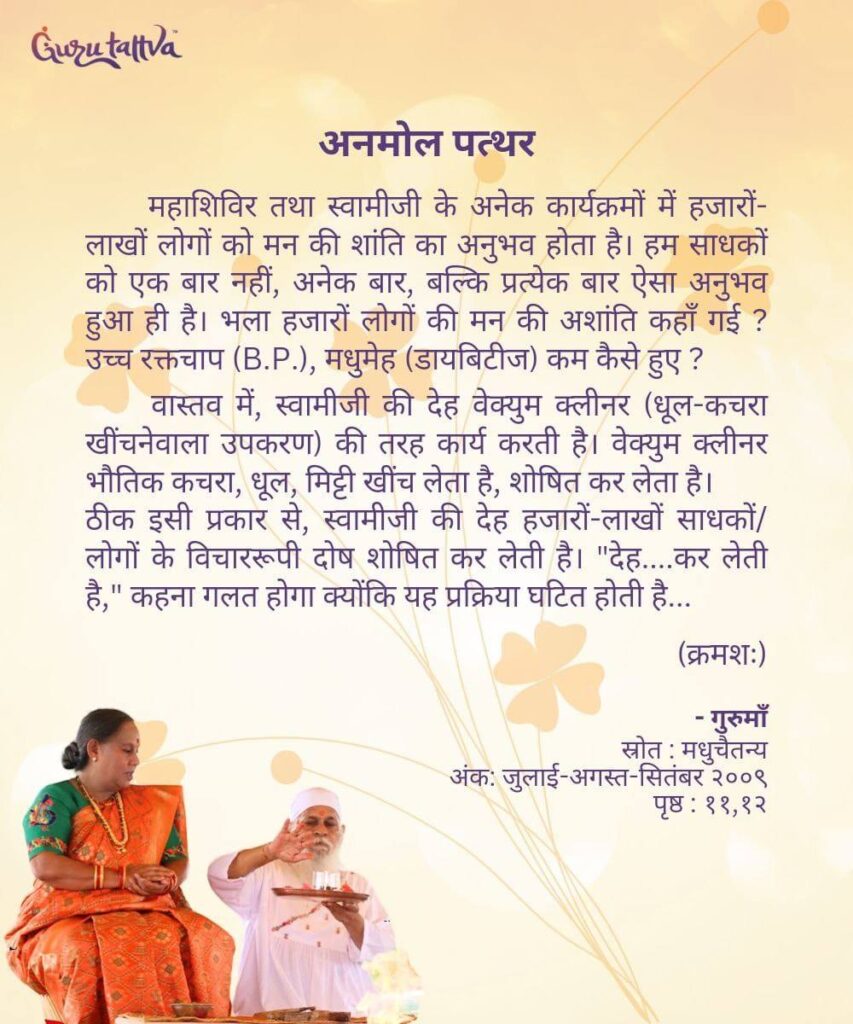
To make a subtle idea easy to grasp, Guru Maa compares Swamiji’s presence to a vacuum cleaner. A vacuum cleaner draws in dust, dirt and loose particles from a room and leaves the space cleaner than before. In the same way, she writes, in Swamiji’s presence the disturbing thoughts of seekers are drawn away, so that their minds are left clearer.
The image is a metaphor, not a literal description. It points to the belief, common in many spiritual traditions, that the presence of a realised master creates an atmosphere in which the mind settles more easily. What is “removed” is not anything physical but the restlessness and negativity that people carry in their thoughts.
“It happens”, rather than “he does it”
Guru Maa then adds an important correction to her own comparison. She points out that it would not be accurate to say that Swamiji’s body actively does this work. The process, in her words, simply takes place.
To say that the body “does” this would be wrong, because this process happens on its own.
— Guru Maa, Madhuchaitanya, July–September 2009, pp. 11–12
This distinction matters in the Samarpan tradition. The Guru is not seen as someone performing a technique on others. A useful comparison is the sun: it does not try to give light, light simply radiates from it. In the same spirit, seekers understand the calm they feel as something that happens naturally in the presence of the Guru, when they sit with an open heart, rather than something that is done to them.
Why collective meditation feels different
Meditating alone at home and meditating in a hall with thousands of others are often experienced very differently. Practitioners of Samarpan Dhyanyog describe collective meditation as especially powerful: the atmosphere becomes still, and it becomes easier for an individual mind to let go of its own noise. A Mahashivir, where many seekers gather for several days, is designed around this shared practice.
Several things help a seeker take part fully:
- Coming with openness and trust instead of a list of expectations.
- Sitting quietly and letting thoughts settle without fighting them.
- Keeping attention gently inward rather than on what others are doing.
- Continuing a short daily practice at home after the programme ends.
A note on health
Some devotees speak of feeling better physically after these programmes. Such accounts are personal experiences. Meditation is widely practised for relaxation and mental calm, but it is not a medical treatment and should never replace advice or care from a qualified doctor. Anyone with a health condition should continue the treatment their doctor recommends.
Bringing the teaching into daily life
The lesson of Guru Maa’s article is not only about large gatherings. It reminds us that peace is not something we can manufacture by effort alone; it arises when we stop resisting and allow ourselves to become still. A few minutes of quiet meditation each day, done with humility and without demands, is a way of opening the windows of a dusty room so that fresh air can come in.
मूल लेख (हिन्दी)
गुरुमाँ ने मधुचैतन्य (जुलाई-अगस्त-सितंबर 2009) में लिखा कि अनमोल पत्थर महाशिविर और स्वामीजी के अनेक कार्यक्रमों में हजारों साधक मन की शांति का अनुभव करते हैं, और यह अनुभव एक बार नहीं, बार-बार होता है। इसे समझाने के लिए उन्होंने वेक्युम क्लीनर का उदाहरण दिया। मूल लेख की कुछ पंक्तियाँ:
वास्तव में, स्वामीजी की देह वेक्युम क्लीनर की तरह कार्य करती है… “देह….कर लेती है,” कहना गलत होगा क्योंकि यह प्रक्रिया घटित होती है…
— गुरुमाँ, स्रोत: मधुचैतन्य, जुलाई-अगस्त-सितंबर 2009, पृष्ठ 11, 12
Key takeaways
- Many seekers repeatedly feel inner peace at the Anmol Pathar Mahashivir and Swamiji’s programmes.
- Guru Maa compares Swamiji’s presence to a vacuum cleaner that draws away the mind’s disturbing thoughts.
- She stresses that this is not something “done” but a process that happens on its own.
- Collective meditation, approached with openness, makes it easier for the mind to settle.
- Meditation supports inner calm; it is not a substitute for medical care.
This article shares the teachings of Shree Shivkrupanand Swamiji and Guru Maa as understood by practitioners; it is not medical advice.